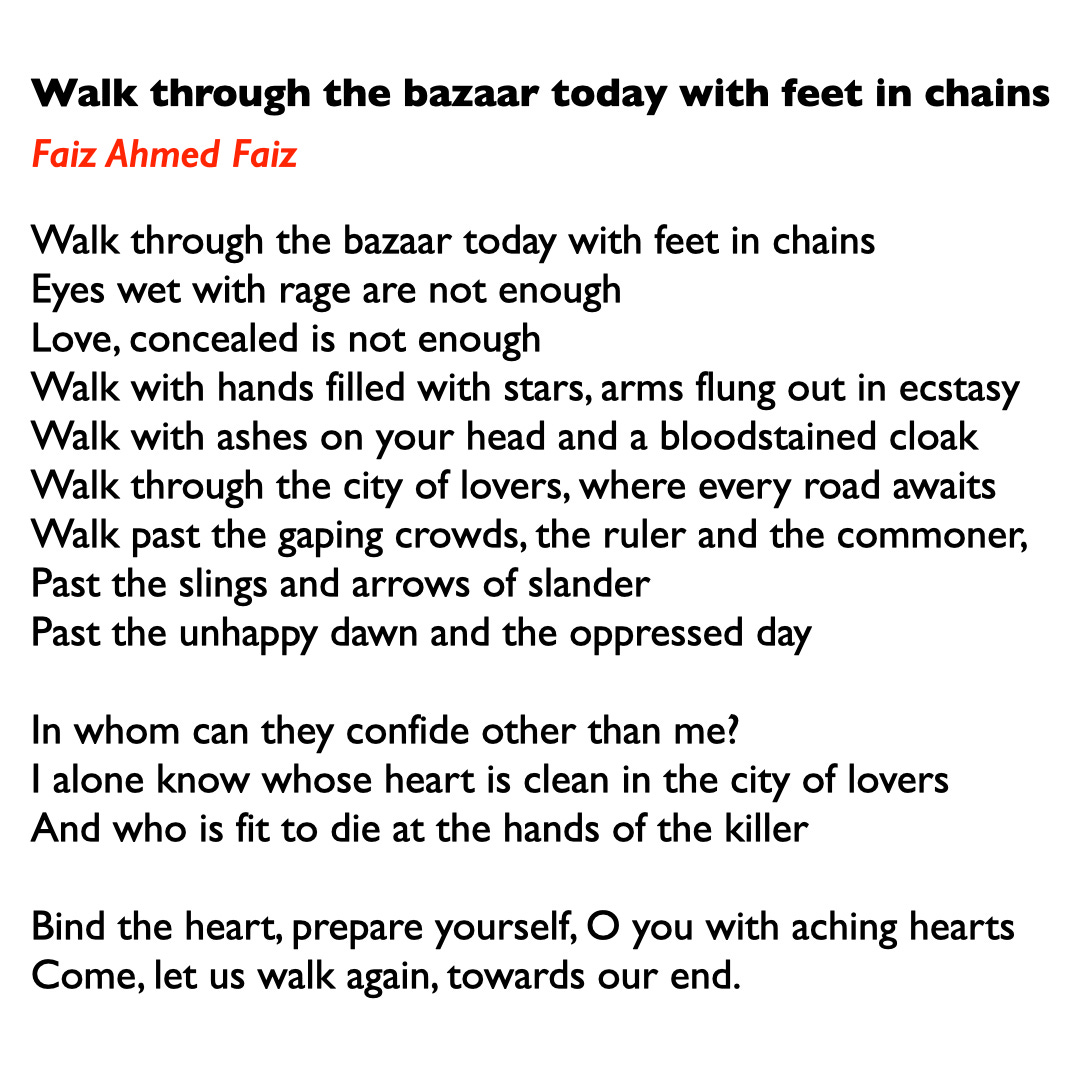
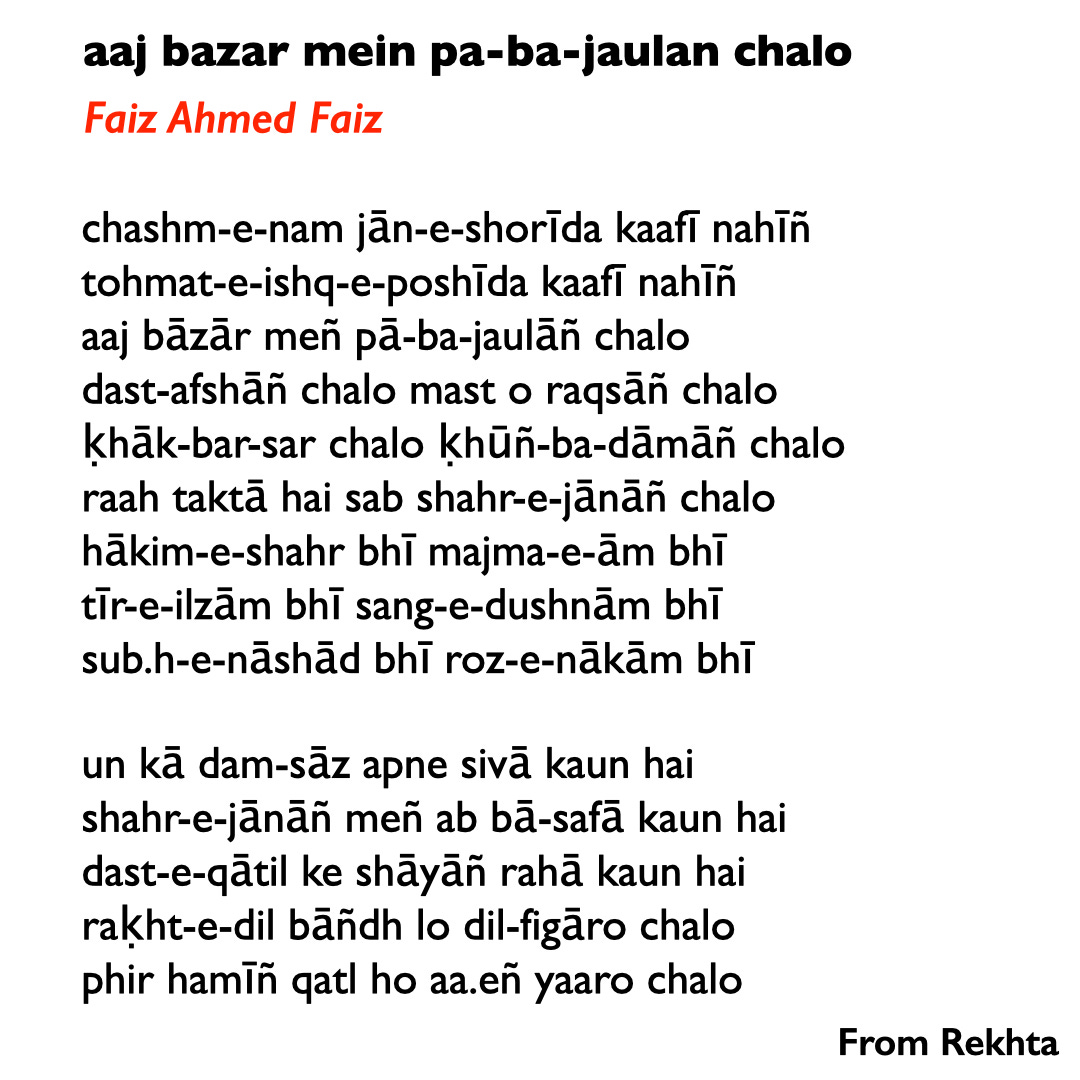
aaj bazaar main pa bajolan chalo let us walk in bazaar in shackles
Chashm-e-nam, jaan-e-shoreeda kafi nahin wet eyes and restless soul is not enough
Tohmat-e-ishq-posheeda kafi nahin being charged for nurturing concealed love is not enough
aaj bazaar main pa-bajolan chalo let us walk in bazaar in shackles
Dast afshan chalo, mast-o-raqsan chalo let us go with afshan in hand, in trance and dancing
Khak bar sar chalo, khoon badaman chalo go with dust on head and blood on garb
Rah takta hai sub shehr-e-janaan chalo Go as the city of my beloved is waiting
Hakim-e-shehr bhi, majma-e-aam bhi City’s ruler and crowd of commoners
Teer-e-ilzam bhi, sang-e-dushnam bhi arrow of false charge, stone of accusation
Subh-e-nashaad bhi, roz-e-naakaam bhi morning of sorrow, day of failure
Unka dum-saaz apnay siwa kaun hai who is their friend except me
Shehr-e-janaan main ab baa-sifa kaun hai who is untainted in the city of beloved
Dast-e-qatil kay shayan raha kaun hai who deserve the killers or executioners hand
Rakht-e-dil bandh lo, dil figaro chalo get ready for the journey of heart, go wounded heart
Phir hameen qatl ho aain yaro chalo let me go to be executed
In addition to vocabulary, Urdu poetry has also acquired its richness from Persian. Perhaps similarities in culture and religion also helped our poetry to absorb Persian traditions. As an example see following Persian couplet:
Mayan-e ma o zahid een qadur ber farq daa Ke mun der ko chau bazaar o der khana me raqsadi
Translation: (The only difference between me and zahid (a pious man) is that I dance in bazaar and streets and he dances within the four walls of his home).
Here the word raqs includes all those acts that society regards as sin. However, the real beauty lies in the meaning that is beyond words. We both are sinners; the difference is that I sin openly and he (who is called pious) sins quietly. One can also say that he is admitting that he is a sinner but zahid is not only a sinner but also a hypocrite. He is saying that the world knows what he is but does not know what zahid is. No matter how you try to understand the poet is expressing a deep disdain for munafiqat and deceitfulness.
I do not know Persian but have quoted it as an example as to how Urdu poetry has borrowed depth and rich traditions from Persian. There are two words in the Persian couplet that I have quoted that Faiz’s has also used: Bazaar and raqs. Incidentally both words symbolize more or less similar meaning in Urdu as well as Persian verses.
The poem’s literal meaning is easy to appreciate. If someone does not understand a word or two then dictionary would help. However, the poem’s beauty is wrapped in a language of symbols, references, metaphors and similes. The theme of the poem is defiance as against compliance and submissiveness. There is a burning desire in a confined soul to be free of restrictions, exploitation and injustice.
In the first seven lines he is referring to love that could be a personal affair and nothing to do with the society at large. But a little reflection would reveal that the real meaning is different then superficial meaning. He is willing to face public ridicule and wrath of the powerful for his love. Wet eye and restive soul are the symbol of endurance in silence as against walking in shackles, dancing in bazaar and blood on garb is a sign of defiance. As if he can not endure to suffer in silence any more. He is sick and tired of the restraints and limits placed by the society and by those who have power; political masters, social order, age old traditions, the religious establishment and the society at large.
The poet’s path takes an obvious turn from the eighth line when he talks of the ruler and the crowd; a symbol of power, established order and manipulation of commoners by ruler or moulvi. The imagery is extremely powerful. How he is made a target of falsehood. Though he fights, he is also full of sadness because he knows that truth will not prevail. That is why he talks of morning of sorrow and of day full of grief in the tenth line.
However, he does not let his sorrow overcome the purpose he has set for himself: to fight for the dispossessed. Here it is important to keep in mind who is he referring to when he said unka in eleventh line; clearly unka includes all downtrodden, exploited and deprived. When he says who is their friend except me, he is in fact grieving that all those who could take a stand are now corrupted and he does not find a single pure soul (ba-sifa). Hence, he feels that he is left to fight against injustice. Finally he gets ready to offer the supreme sacrifice.
References to concealed love and city of beloved should not be confused with poetry of ordinary love in the traditional sense. As love is symbol of purity and a true lover can not be a hypocrite that is why he has used that symbol. His main theme is to fight against injustice and repressive forces of the society.
Faiz’s Aaj Baazaar Mein – Translated and Explained
Last updated on: November 1, 2022 at 1:05 pm by Andrew Harvey
How is it that entire discourses of resistance can be launched in a few precisely chosen words, haiku-like in their delineation of the landscape? Entire systems of oppression can be brought to their knees by the utterance of truths that are juxtaposed with the raw nakedness of sight. When I first shared Simic’s lines on this platform, I did not speak so much about their revolutionary power. I spoke about sparseness, and how the world could be compressed into words that in their singularity, convey, not only image, but movement, and a complex interplay of ideas beyond the static frame of the poem itself. Simply, through juxtaposition, Simic lays bare what education can become, how ‘empire’ tightens its grip through the prisons it creates, even for its children.
Last Saturday, newspapers reported that verses of Faiz (among other allegedly ‘incendiary’ posters and content) were removed from 10th standard CBSE Social Science Textbooks. Among other quotes, the translation of a passage from this poem was excluded.
The translation I have done is culled and recreated from different sources including the version used in the Merchant Ivory production ‘In Custody’, and Rekhta.
Can empire erase memory? Can it rewrite history? It is attempting to, and even creating versions of it to suit its thorny project of colonising the present, with imagined pasts. The thing that the empire fears the most is love. It fears openness of expression, empathy, and calls for unity. It fears the surging ocean that laughter can bring. It fears irony, and the upturned head of a man walking through the bazaar with shackles on his feet. It fears defiance, and the refusal to accept humiliation and punishment.
Faiz’s landmark poem was written when he himself was being taken to jail in chains, for his defiant stance, and his open satire, and critique of fascist policies. ‘Walk past the gaping crowds’, he says. Let the fetters shine in the sun. Let them see you laugh, and ‘dance in ecstasy’ – no shackles can imprison the imagination.
This is what the empire fears – that its subjects can ride on the wings of imagination, something that they cannot control. What fake imagery, and violent rhetoric will you thrust in ‘hands filled with stars’? Fascists require the slate to be clean, that children can be conditioned into their limited fantasies of purity. They see children as the footsoldiers of their vision, and they use the double-edge sword of censorship and propaganda to aid this endeavour. Their anti-intellectualism is marked by the threat of the creation of ideas, of curiosity. They want to quell individuality, and the possibility of realities that do not suit their agenda, imaginations that they cannot regulate.
Sometimes, I feel, that the best thing that a government can do a text is ban it. I remember the sudden interest that was garnered around A. K. Ramanujan’s essay “Three Hundred Ramayanas” which was removed by the UGC from College syllabi. I was a student, at the time, and was perplexed by the logic of that removal. The fascinating essay propelled mythology as multi-faceted, open ended, and constantly evolving – more retelling, than sacrament. Ramanujan opened up a world of colourful, diverse mythologies for me, and made me love the changing narratives of gods and people, in a manner that was not restricted, and that taught me about the complex scripts of culture. Faiz’s words have done this too, for many, even years after they were written. They have the power to gather crowds.
What a state cannot understand, it attempts to decimate, but the shard of light that is knowledge, shines through the crack, always.
I share these verses in solidarity, today, and in the hope that our young may learn of the constant attempts to kill ideas, and the value of equality.
If the poetry and the commentary resonate with you, do consider ‘buying me a coffee’.
(Matlab, if you can’t, that’s also fine, obviously. This will always be a free newsletter)
—
Note: Those, not in India, who’d like to support the work I do at Poetly, do write to me – poetly@pm.me. (Apologies, I will figure out international payments soon)
Video message by António Guterres, Secretary-General of the United Nations, on the International Day to Combat Islamophobia 2026 (15 March).
“The world’s 2 billion Muslims hail from all corners of the globe, reflecting the vast diversity of humanity itself. Yet they often face institutional discrimination, socio-economic exclusion, biased immigration policies, and unwarranted surveillance and profiling. These worrying trends are fuelled by anti-Muslim rhetoric and outright hate, which can lead to harassment and violence against individuals and places of worship.
Governments must take concrete steps to address hate speech, protect religious freedom and combat discrimination, including by ensuring full compliance with international human rights law.
Online platforms must work to wipe out hate speech and harassment against people based on their religion or belief.
And all people need to speak out against bigotry, xenophobia and discrimination wherever they find it.
दुनिया के दो अरब मुसलमान दुनिया के हर कोने से आते हैं, जो मानवता की विशाल विविधता को दर्शाते हैं। फिर भी, उन्हें अक्सर संस्थागत भेदभाव, सामाजिक-आर्थिक बहिष्कार, पक्षपातपूर्ण आप्रवासन नीतियों और अनुचित निगरानी व प्रोफाइलिंग का सामना करना पड़ता है।
ये चिंताजनक प्रवृत्तियाँ मुस्लिम-विरोधी बयानबाज़ी और खुली नफरत से बढ़ती हैं, जो व्यक्तियों और पूजा स्थलों के खिलाफ उत्पीड़न और हिंसा का कारण बन सकती हैं। सरकारों को घृणास्पद भाषण से निपटने, धार्मिक स्वतंत्रता की रक्षा करने और भेदभाव को समाप्त करने के लिए ठोस कदम उठाने चाहिए, जिसमें अंतरराष्ट्रीय मानवाधिकार कानून का पूर्ण पालन सुनिश्चित करना भी शामिल है।
ऑनलाइन प्लेटफॉर्म्स को धर्म या आस्था के आधार पर लोगों के खिलाफ घृणास्पद भाषण और उत्पीड़न को समाप्त करने के लिए काम करना चाहिए, और सभी लोगों को जहां भी वे कट्टरता, ज़ेनोफोबिया और भेदभाव देखें, उसके खिलाफ आवाज़ उठानी चाहिए।
इसीलिए, मई 2025 में, मैंने सभ्यताओं के गठबंधन के प्रतिनिधि को इस्लामोफोबिया से निपटने के लिए संयुक्त राष्ट्र का विशेष दूत नियुक्त किया, ताकि हमारी सामूहिक प्रतिक्रिया को मजबूत किया जा सके।
इस्लामोफोबिया से निपटने के अंतरराष्ट्रीय दिवस पर, आइए हम हर व्यक्ति की समानता, मानवाधिकार और गरिमा के प्रति अपनी प्रतिबद्धता को दोहराएं, चाहे उनका धर्म कुछ भी हो। आइए हम हर देश और समुदाय से इस्लामोफोबिया के इस अभिशाप को समाप्त करें।
The world’s two billion Muslims hail from all corners of the globe, reflecting the vast diversity of humanity itself. Yet they often face institutional discrimination, socioeconomic exclusion, biased immigration policies, and unwarranted surveillance and profiling.
These worrying trends are fueled by anti-Muslim rhetoric and outright hate, which can lead to harassment and violence against individuals and places of worship. Governments must take concrete steps to address hate speech, protect religious freedom, and combat discrimination, including by ensuring full compliance with international human rights law.
Online platforms must work to eliminate hate speech and harassment against people based on their religion or belief, and all people need to speak out against bigotry, xenophobia, and discrimination wherever they find it.
That is why, in May 2025, I appointed the representative for the Alliance of Civilizations as the UN Special Envoy to Combat Islamophobia, to enhance our collective response.
On this International Day to Combat Islamophobia, let us recommit to the equality, human rights, and dignity of every person, no matter their faith. Let us eradicate the scourge of Islamophobia from every country and community.
That’s why I appointed in May 2025 the High Representative for the Alliance of Civilizations as the UN Special Envoy to Combat Islamophobia to enhance our collective response.
On this International Day to Combat Islamophobia, let’s re-commit to the equality, human rights and dignity of every person, no matter their faith.
Let’s eradicate the scourge of Islamophobia from every country and community”.
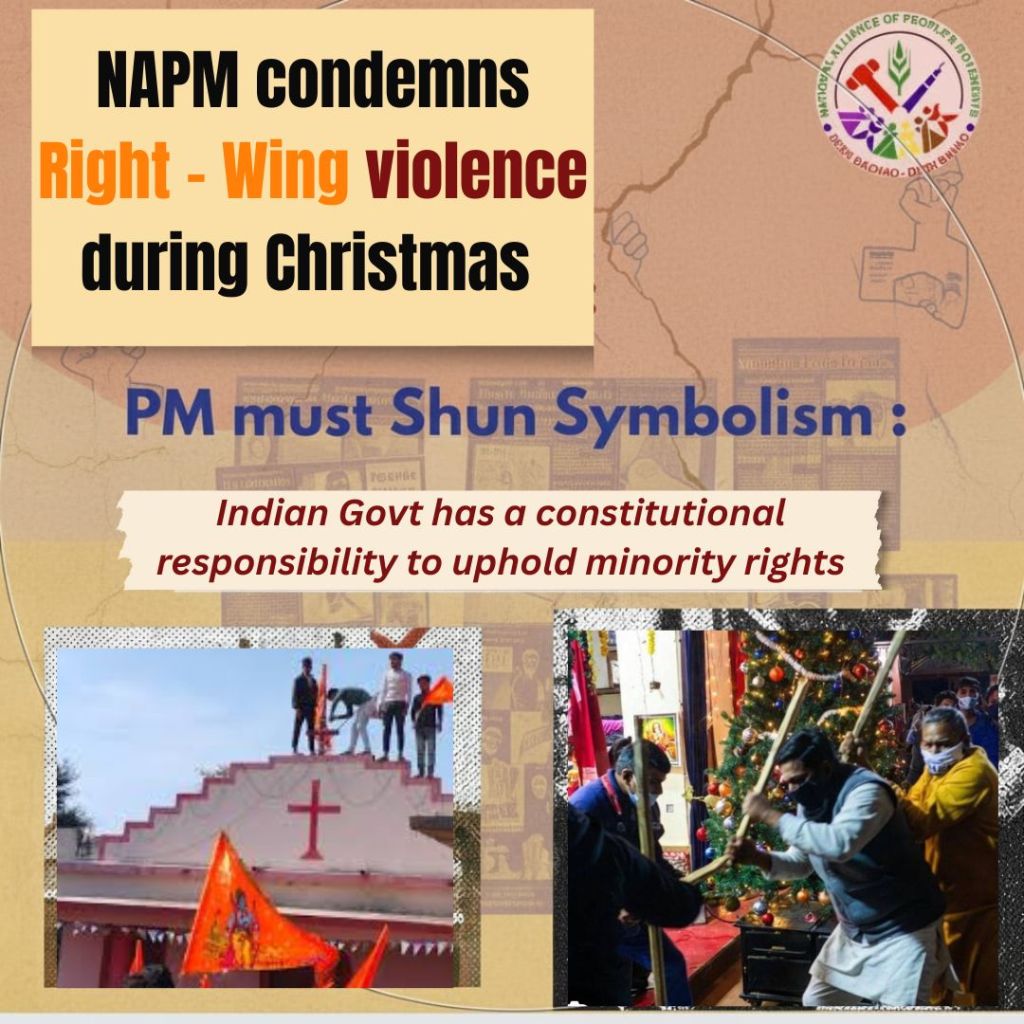
Right-wing Hate & Violence during Christmas Condemnable:
PM must shun hollow symbolism: Indian Govt has a constitutional responsibility to uphold rights, safety and dignity of religious minorities
4th January, 2026: National Alliance of People’s Movements (NAPM) and Sadbhav Manch strongly condemns the widespread attacks and hooliganism by right-wing forces during the recent Christmas festivities. This is part of the rising pattern of hate-filled violence that is being inflicted upon religious minorities in India, in particular against Muslims and Christians. While on the one hand, the Prime Minister exhibits hollow symbolism, on the other hand, crimes against minorities are on a relentless rise on the ground. We condemn the hypocrisy, targeted violence and call for accountability of the state towards the constitutional and human rights of religious minorities in India, including their right to safety, dignity and freedom to practice faith, fearlessly.
The persecution of Christians in India has been a cause of growing concern, especially in the past decade. In the month of December 2025 alone, while preparations for Christmas festivities were on, right-wing extremists indulged in targeted attacks, disrupting carol singings and church services, across different states of India. The working-class vendors selling Santa Claus caps on the roads for their livelihood were brutally beaten up; people and shop-owners were asked to boycott Christian festivals. Much of this hatred, violence and intimidation has been led by groups believing in the hateful Hindutva ideology, claiming to ‘save Indian culture’. At multiple places these attempts have received official patronage in direct and indirect ways. These incidents collectively constitute direct violations of Articles 14, 15, 19, 21, and 25 to 28 of the Constitution of India.
We also strongly call out the dichotomy in the optics and actions of the powers-that-be. During recent months, while the Prime Minister and the Vice President of India publicly participated in Christmas celebrations, there was little firm action against those perpetrating violence and intimidation on the ground. NAPM and Sadbhav Manch unequivocally denounce all forms of religious persecution across India. We stand in full solidarity with the oppressed and victims of religious persecution.
Just in the month of December, 2025; numerous hate crimes were reported:In Jhabua, Madhya Pradesh, authorities denied permission to conduct traditional Christmas carol singing, citing imaginary threats of conversion. Only after intervention by the Indore High Court Bench on 18th December, 2025, these unconstitutional orders were quashed.On 20th December, 2025, a lunch organized for visually challenged students at a church in Jabalpur was violently disrupted by a BJP woman leader making baseless allegations of ‘forced conversion’.In Kerala, on the night of 21st December, a children’s Christmas carol group in Palakkad was verbally abused, physically assaulted, and their musical instruments were damaged by persons reportedly linked to the RSS. In Delhi, the national capital, on 22nd December, Christian women and children wearing Santa Claus hats were harassed in Lajpat Nagar market by Bajrang Dal members who accused them of ‘proselytization’. Around the same time in Bhubaneswar, Odisha, roadside vendors selling Christmas items were intimidated and forced to shut down sales by individuals invoking ‘Hindu Rashtra’ rhetoric. On 22nd December, in Pune, members reportedly affiliated to the VHP and Bajrang Dal threatened a petrol pump owner at Bhavani Peth, over employees wearing Christmas hats.The petrol pump owner registered a complaint at the police station.In Chhattisgarh, a dispute over burial rites in Kanker district, escalated on 18th December, 2025, into mob violence, arson of Christian homes and prayer halls, and injuries. Survivors alleged instigation by Hindutva groups, pointing to the deepening vulnerability of adivasi Christian communities. On 24th December, members affiliated with the Vishwa Hindu Parishad and the Bajrang Dal allegedly disrupted Christmas Eve celebrations and vandalized decorations at St. Mary’s English School in Nalbari, about 65 km from Guwahati in Assam.In Uttar Pradesh, the decision to keep schools open on 25th December, cancelling the traditional official Christmas holiday while mandating celebrations of a political leader’s birth anniversary, sends a deeply exclusionary message to minority communities.
The Constitution of India is based on the principles of secularism and the State is mandated to maintain an equal distance from all religions. But the repeated incidents of communal hatred and violence depict a different reality, with right-wing groups attacking the Christian festivals, calling them ‘alien’ to Indian culture, and interpreting all collective prayer, carol singing and functions as ‘forced conversion’ efforts.
The ill-conceived bogie of ‘involuntary conversion’, constant misuse of anti-conversion laws, arbitrary arrests, denial of permissions, and failure to protect fundamental rights of minorities during their religious practices & festivals represent a systemic breakdown of constitutional governance in the country under the Modi Government. National Alliance of People’s Movements (NAPM) & Sadbhav Manch, along with multiple secular, rights-based organizations across India, urgently call upon the Union Home Minister to intervene without delay and issue clear directions to all States and Union Territories to:
Prevent violence, intimidation, harassment of Christians or Muslims, during festivals, or otherwise.
Ensure strict, prompt and unbiased action against groups and individuals involved in hate speech, hate crimes, intimidation, and violence.
Provide adequate protection to churches, mosques, prayer halls, carol groups, and community celebrations.
Compensate all workers, citizens and minority communities that have suffered losses of livelihood or impact to faith-institutions because of hate-crimes.
Fix accountability of police and district administration for illegal detentions, denial of fundamental freedoms, and failure to prevent mob violence.
Stop abuse of anti-conversion laws that are only being invoked to terrorize minorities, with no actual convictions. No arrest should be made without full investigation, evidence and judicial scrutiny. A comprehensive review of all anti-conversion laws from a constitutional justice perspective is the need of the hour.
The continued silence of the Union Ministry of Home Affairs; along with local administration’s inaction, only emboldens the hooligans and normalizes mob rule of these ‘fringe elements’ (who have now become the mainstream), placing the very constitutional secular fabric of the country at risk. The incidents of hatred and violence against minorities are higher in states led by BJP government, hence the leaders of the ruling party at the Centre, need to effectively address the violations, beyond optics and symbolism.
As people’s movements and civil society groups committed to secular principles enshrined in the Indian Constitution, we stand in unflinching solidarity with all victims of hate crimes and reaffirm our profound commitment to pursue democratic and legal remedies, until justice is ensured and the rule of law is restored. We will work to strengthen efforts for justice to all the marginalized minority groups – religious, linguistic, caste, race, gender, ethnic and call upon the Union of India to ensure the same.
Issued by: Sadbhav Manch – National Alliance of People’s Movements (NAPM)
प्रधानमंत्री को खोखले प्रतीकात्मक राजनीति से बचना चाहिए: धार्मिक अल्पसंख्यकों के अधिकारों, सुरक्षा और गरिमा को बनाए रखना भारत सरकार का संवैधानिक दायित्व है!
4 जनवरी, 2026: जन आंदोलनों का राष्ट्रीय समन्वय (NAPM) और सदभाव मंच, क्रिसमस के मौके पर हुई नफरती हिंसा और गुंडागर्दी की कड़े शब्दों में निंदा करते हैं। देश में ईसाई और मुस्लिम समुदायों के खिलाफ़ नफ़रत का जो माहौल बनाया जा रहा है, वह बेहद चिंताजनक है। एक तरफ प्रधानमंत्री क्रिसमस के कार्यक्रमों में शामिल होकर दिखावा कर रहे हैं, तो दूसरी तरफ़ जमीन पर अल्पसंख्यकों पर हमले बढ़ रहे हैं। हम राज्य से यह मांग करते हैं कि वह अपनी जिम्मेदारी निभाते हुए, धार्मिक अल्पसंख्यकों की संवैधानिक व मानव अधिकार, खासकर सुरक्षा, सम्मान और निडरता से अपने धर्म की अभिव्यक्ति के अधिकार को सुनिश्चित करे।
भारत में ईसाइयों का उत्पीड़न पिछले एक दशक से बढ़ती हुई चिंता का विषय रहा है । दिसंबर 2025 के महीने में ही, जब क्रिसमस पर्व की तैयारियाँ चल रही थीं, तब दक्षिणपंथी ताकतों ने उन्हें निशाना बनाया। उन्होंने भारत के अलग-अलग राज्यों में कैरोल गायन और चर्च की प्रार्थनाओं में विघ्न डाला । सड़कों पर अपनी आजीविका के लिए सांता क्लॉज़ की टोपियाँ बेचने वाले गरीब रेहड़ी-पटरी वालों को बेरहमी से पीटा गया । लोगों और दुकानदारों से ईसाई त्योहारों का बहिष्कार करने को कहा गया । इस नफ़रत, हिंसा और डराने-धमकाने का कार्य काफी हद तक घृणा-भरी ‘हिंदुत्व विचारधारा’ में विश्वास रखने वाले समूहों ने किया, जो ‘भारतीय संस्कृति बचाने’ का दावा करते हैं । कई जगहों पर इन कोशिशों को प्रत्यक्ष या परोक्ष रूप से आधिकारिक संरक्षण भी प्राप्त हुआ ।
ये घटनाएँ सामूहिक रूप से भारत के संविधान के अनुच्छेद 14, 15, 19, 21 और 25 से 28 का सीधा उल्लंघन हैं । हम सत्ता में बैठे लोगों की बातों और उनके काम के बीच के इस बड़े फर्क की कड़ी निंदा करते हैं।पिछले कुछ महीनों में, एक तरफ जहाँ प्रधान मंत्री और उप-राष्ट्रपति क्रिसमस के कार्यक्रमों में शामिल हुए, वहीं दूसरी तरफ जमीन पर हिंसा और डराने-धमकाने वालों के खिलाफ़ कोई सख्त कार्यवाही नहीं लिया गया। जन आंदोलनों का राष्ट्रीय समन्वय (NAPM) और सद्भाव मंच भारत में धर्म के नाम पर होने वाले हर जुल्म के खिलाफ़ हैं। हम उन सभी लोगों के साथ मज़बूती से खड़े हैं जिनका उत्पीड़न किया जा रहा है।
भारत का संविधान धर्मनिरपेक्षता के सिद्धांतों पर आधारित है और सरकार की यह जिम्मेदारी है कि वह सभी धर्मों से एक समान दूरी बनाए रखे। लेकिन सांप्रदायिक नफ़रत और हिंसा की बार-बार होने वाली घटनाएं एक अलग ही हकीकत बयां करती हैं। दक्षिणपंथी संगठन ईसाई त्योहारों पर हमले कर रहे हैं, उन्हें भारतीय संस्कृति के लिए ‘अजनबी’ बता रहे हैं, और हर सामूहिक प्रार्थना, कैरोल गायन और कार्यक्रम को ‘जबरन धर्मांतरण’ की कोशिश करार दे रहे हैं। ‘जबरन धर्मांतरण’ का यह गलत डर फैलाना, धर्मांतरण विरोधी कानूनों का लगातार दुरुपयोग, मनमानी गिरफ्तारियां, त्योहार मनाने के लिए अनुमति न देना और धार्मिक आयोजनों के दौरान अल्पसंख्यकों के मौलिक अधिकारों की रक्षा करने में विफलता—ये सब मोदी सरकार के तहत देश में संवैधानिक शासन की नाकामी को दर्शाते हैं।
केवल दिसंबर 2025 के महीने में ही नफ़रत और जुल्म की कई खबरें आईं:
झाबुआ: प्रशासन ने धर्मांतरण का बहाना बनाकर क्रिसमस कैरोल पर रोक लगा दी। 18 दिसंबर को हाई कोर्ट के दखल के बाद ही यह पाबंदी हट सकी। जबलपुर: 20 दिसंबर को एक चर्च में नेत्रहीन बच्चों के खाने के प्रोग्राम को बीजेपी की एक महिला लीडर ने रुकवा दिया और उन पर झूठे इल्जाम लगाए। केरल: 21 दिसंबर की रात पलक्कड़ में क्रिसमस गा रहे बच्चों के साथ मारपीट की गई और उनके बाजे तोड़ दिए गए। दिल्ली: 22 दिसंबर को लाजपत नगर में सांता कैप पहनी महिलाओं और बच्चों को बजरंग दल के लोगों ने डराया-धमकाया। भुवनेश्वर: क्रिसमस का सामान बेचने वाले छोटे दुकानदारों को डराकर उनकी दुकानें बंद करा दी गईं। पुणे: 22 दिसंबर को एक पेट्रोल पंप के कर्मचारियों के सांता कैप पहनने पर VHP और बजरंग दल के लोगों ने मालिक को धमकी दी। छत्तीसगढ़ के कांकेर जिले में 18 दिसंबर, 2025 को अंतिम संस्कार के रीति-रिवाजों को लेकर शुरू हुआ विवाद इतना बढ़ गया कि भीड़ ने हिंसा और आगजनी शुरू कर दी। ईसाइयों के घरों और प्रार्थना केंद्रों को जलाया गया और कई लोग घायल हुए। वहां रहने वालों का आरोप है कि हिंदुत्ववादी संगठनों ने भीड़ को भड़काया, जिससे आदिवासी ईसाई समुदायों की असुरक्षा और बढ़ गई है। असम में 24 दिसंबर को गुवाहाटी से करीब 65 किलोमीटर दूर नलबाड़ी में, VHP और बजरंग दल के लोगों ने ‘संता मैरी इंग्लिश स्कूल’ में क्रिसमस ईव के जश्न को रुकवाया और वहां की सजावट में तोड़फोड़ की। उत्तर प्रदेश में 25 दिसंबर की पारंपरिक सरकारी छुट्टी को रद्द करके स्कूलों को खुला रखने और एक राजनीतिक नेता की जयंती मनाने का फैसला लिया गया। यह अल्पसंख्यक समुदायों को समाज से अलग-थलग करने वाला एक गहरा संदेश देता है।
जन आंदोलनों का राष्ट्रीय समन्वय (NAPM) और सद्भाव मंच, भारत भर के कई धर्मनिरपेक्ष और अधिकार-आधारित संगठनों के साथ मिलकर, केंद्रीय गृह मंत्री से बिना किसी देरी के हस्तक्षेप करने और सभी राज्यों और केंद्र शासित प्रदेशों को स्पष्ट निर्देश जारी करने की मांग करते हैं कि:
ईसाईयों या मुसलमानों के त्योहारों के दौरान, या किसी भी समय, उनके खिलाफ़ होने वाली हिंसा, धमकी और उत्पीड़न को रोका जाए।
चर्चों, मस्जिदों, प्रार्थना स्थलों, कैरोल समूहों और सामुदायिक कार्यक्रमों को पर्याप्त सुरक्षा मुहैया कराई जाए।
उन सभी श्रमिकों, नागरिकों और अल्पसंख्यक समुदायों को मुआवज़ा दिया जाए जिन्हें नफ़रत भरे अपराधों की वजह से अपनी आजीविका का नुकसान उठाना पड़ा है या जिनके धार्मिक स्थलों पर हमला हुआ है।
अवैध हिरासत, मौलिक अधिकारों के हनन और भीड़ की हिंसा को रोकने में नाकाम रहने वाले पुलिस और जिला प्रशासन की जवाबदेही तय की जाए।
धर्मांतरण विरोधी कानूनों के दुरुपयोग को रोका जाए, जिनका इस्तेमाल केवल अल्पसंख्यकों को डराने के लिए किया जा रहा है और जिनमें सजा की दर शून्य है। बिना पूरी जांच, सबूत और अदालती निगरानी के कोई गिरफ्तारी नहीं होनी चाहिए। संवैधानिक न्याय के नज़रिए से इन सभी कानूनों की समीक्षा की जाए।
केंद्रीय गृह मंत्रालय की लगातार चुप्पी और स्थानीय प्रशासन की ढिलाई इन उपद्रवी तत्वों के हौसले बढ़ा रही है और भीड़ के राज को सामान्य बना रही है। ये तथाकथित ‘अराजक तत्व’ अब मुख्यधारा बन चुके हैं, जिससे देश का धर्मनिरपेक्ष ढांचा खतरे में है। अल्पसंख्यक विरोधी हिंसा की घटनाएं विशेष रूप से भा.ज.पा शासित राज्यों में ज्यादा हैं, इसलिए केंद्र में सत्ताधारी पार्टी के नेताओं को केवल दिखावे और प्रतीकों से ऊपर उठकर, इन उल्लंघनों पर ठोस कदम उठाने चाहिए।
भारतीय संविधान में निहित धर्मनिरपेक्ष सिद्धांतों के प्रति कटिबद्ध जन आंदोलनों और नागरिक समाज समूहों के रूप में, हम नफ़रत के शिकार सभी पीड़ितों के साथ मज़बूती से खड़े हैं।न्याय और कानून का राज स्थापित करने के लिए हम लोकतांत्रिक रास्ता अपनाने के लिए प्रतिबद्ध हैं। हम धार्मिक, भाषाई, जाति, नस्ल या लिंग के आधार पर वंचित अल्पसंख्यक समूहों के लिए न्याय सुनिश्चित करने हेतु अपने प्रयासों को सुदृढ़ करेंगे और भारत सरकार से भी यही अपेक्षा करते हैं।
जारीकर्ता:सद्भाव मंच – जन आंदोलनों का राष्ट्रीयसमन्वय (एन.ए.पी.एम)
India is internationally recognised for its civilisational ethos of Vasudhaiva Kutumbakam—the belief that the world is one family—which reflects the country’s long-standing commitment to diversity, pluralism, and mutual respect among religions and cultures. This inclusive tradition has historically enabled people of different faiths to celebrate each other’s festivals with joy and camaraderie.
In this context, reports of attacks targeting Christmas celebrations in the year 2025 across various parts of India is deeply distressing. In Assam, St Mary’s School in Panigaon village, Nalbari district, was vandalised, with festival-related items in shops damaged, Christmas decorations set on fire, and provocative slogans raised. In Jabalpur, Madhya Pradesh, a BJP city vice president publicly abused and physically assaulted a visually impaired woman attending a Christmas feast. Similarly, in Rajasthan, Hindu extremists vandalised a school in Nagaur during Christmas celebrations. In a Mumbai suburb, two Christian women were harassed on December 11 while distributing pamphlets. The men accused them of trying to convert Hindus, even though the women said the pamphlets were only about a church prayer service. These are only examples of some of the attacks. Attacks on Christmas celebrations are only one form of anti-Christian violence. Anti-Christian violence takes different forms, including attacks on prayer meetings, denial of burial space, assaults etc.
The Inter-Religious Solidarity Council (IRSC), Mumbai, unequivocally condemns these acts of violence and intimidation in the strongest possible terms.
We reiterate here that IRSC opposes all religious conversions using force or coercion, or undue inducement, or by use of fraudulent means, as it militates against the principle of genuine religious freedom. IRSC emphasises that neither violence nor coercion has any place in religious discourse. No religion sanctions violence or hatred against followers of other faiths, just as no true faith can be spread through deceit or compulsion. India’s rich philosophical heritage is grounded in the principle of “yato mat, tato path”, meaning there are as many paths as there are a number of opinions. This idea was eloquently articulated by Swami Vivekananda, who observed that just as rivers from different sources ultimately merge into the sea, diverse spiritual paths—though varied in their practices—lead to the same ultimate truth. His teachings affirmed the legitimacy of multiple paths to spirituality and God. This inclusive vision has shaped India’s social ethos and enabled harmonious coexistence, influenced by the teachings of religious leaders such as the Buddha, Guru Nanak, Swami Vivekananda, Kabir, Mother Teresa, and Nizamuddin Auliya.
Mumbai, in particular, has long stood as an exemplar of cosmopolitan and inclusive living, where Christmas is celebrated with enthusiasm across religious communities. The festival embodies the message of Jesus Christ—love, compassion, and sacrifice.
The IRSC urges the authorities to ensure swift and impartial justice against the perpetrators of these acts of violence and to uphold the constitutional right to freedom of religion for all citizens without fear or favour. The Council also calls upon people of all faiths to reaffirm the spirit of solidarity, mutual respect, and love—the shared moral foundation of all religions—through dialogue and lawful means, rejecting both violence and coercion in favour of genuine understanding.
Prabhu Keshav Chandra Das, Convenor of IRSC
Irfan Engineer, Co-Convenor of IRSC
6th January 2026
Google Translate of above statement by IRSC
ईसाईयों पर हाल के हमलों पर अंतर-धार्मिक एकजुटता परिषद का बयान
भारत को अंतरराष्ट्रीय स्तर पर वसुधैव कुटुंबकम की सभ्यतागत भावना के लिए पहचाना जाता है – यह विश्वास कि दुनिया एक परिवार है – जो देश की विविधता, बहुलवाद और धर्मों और संस्कृतियों के बीच आपसी सम्मान के प्रति लंबे समय से चली आ रही प्रतिबद्धता को दर्शाता है। इस समावेशी परंपरा ने ऐतिहासिक रूप से अलग-अलग धर्मों के लोगों को एक-दूसरे के त्योहारों को खुशी और भाईचारे के साथ मनाने में सक्षम बनाया है।
इस संदर्भ में, 2025 में भारत के विभिन्न हिस्सों में क्रिसमस समारोहों को निशाना बनाकर किए गए हमलों की खबरें बहुत दुखद हैं। असम के नलबाड़ी जिले के पानिगांव गांव में सेंट मैरी स्कूल में तोड़फोड़ की गई, दुकानों में त्योहार से संबंधित सामान को नुकसान पहुंचाया गया, क्रिसमस की सजावट में आग लगा दी गई और भड़काऊ नारे लगाए गए। मध्य प्रदेश के जबलपुर में, बीजेपी के एक शहर उपाध्यक्ष ने सार्वजनिक रूप से एक दृष्टिबाधित महिला को गाली दी और उसके साथ मारपीट की, जो क्रिसमस की दावत में शामिल हुई थी। इसी तरह, राजस्थान के नागौर में, हिंदू चरमपंथियों ने क्रिसमस समारोह के दौरान एक स्कूल में तोड़फोड़ की। मुंबई के एक उपनगर में, 11 दिसंबर को दो ईसाई महिलाओं को पैम्फलेट बांटते समय परेशान किया गया। पुरुषों ने उन पर हिंदुओं को धर्म परिवर्तन कराने की कोशिश करने का आरोप लगाया, जबकि महिलाओं ने कहा कि पैम्फलेट केवल चर्च की प्रार्थना सेवा के बारे में थे। ये हमले केवल कुछ उदाहरण हैं। क्रिसमस समारोहों पर हमले ईसाई विरोधी हिंसा का सिर्फ एक रूप है। ईसाई विरोधी हिंसा कई रूप लेती है, जिसमें प्रार्थना सभाओं पर हमले, दफनाने की जगह से इनकार, मारपीट आदि शामिल हैं।
अंतर-धार्मिक एकजुटता परिषद (IRSC), मुंबई, इन हिंसा और धमकी की घटनाओं की कड़ी शब्दों में निंदा करती है।
हम यहां दोहराते हैं कि IRSC बल या जबरदस्ती, या अनुचित प्रलोभन, या धोखाधड़ी के साधनों का उपयोग करके सभी धार्मिक धर्मांतरण का विरोध करता है, क्योंकि यह वास्तविक धार्मिक स्वतंत्रता के सिद्धांत के खिलाफ है। IRSC इस बात पर जोर देता है कि धार्मिक चर्चा में न तो हिंसा और न ही जबरदस्ती की कोई जगह है। कोई भी धर्म दूसरे धर्मों के अनुयायियों के खिलाफ हिंसा या नफरत को मंजूरी नहीं देता है, ठीक उसी तरह जैसे कोई भी सच्चा धर्म धोखे या जबरदस्ती से नहीं फैलाया जा सकता। भारत की समृद्ध दार्शनिक विरासत “यतो मत, ततो पथ” के सिद्धांत पर आधारित है, जिसका अर्थ है कि जितनी राय हैं, उतने ही रास्ते हैं। इस विचार को स्वामी विवेकानंद ने बहुत अच्छे से व्यक्त किया था, जिन्होंने कहा था कि जिस तरह अलग-अलग स्रोतों से निकलने वाली नदियाँ अंततः समुद्र में मिल जाती हैं, उसी तरह विविध आध्यात्मिक मार्ग – हालांकि उनके अभ्यास अलग-अलग होते हैं – उसी अंतिम सत्य की ओर ले जाते हैं। उनकी शिक्षाओं ने आध्यात्मिकता और ईश्वर तक पहुँचने के कई रास्तों की वैधता की पुष्टि की। इस समावेशी सोच ने भारत के सामाजिक मूल्यों को आकार दिया है और सद्भावपूर्ण सह-अस्तित्व को संभव बनाया है, जो बुद्ध, गुरु नानक, स्वामी विवेकानंद, कबीर, मदर टेरेसा और निज़ामुद्दीन औलिया जैसे धार्मिक नेताओं की शिक्षाओं से प्रभावित है।
खास तौर पर मुंबई लंबे समय से सर्वधर्म समभाव और समावेशी जीवन का एक उदाहरण रहा है, जहाँ सभी धार्मिक समुदायों में क्रिसमस पूरे उत्साह के साथ मनाया जाता है। यह त्योहार यीशु मसीह के संदेश – प्रेम, करुणा और बलिदान – को दर्शाता है।
IRSC अधिकारियों से आग्रह करता है कि वे हिंसा की इन घटनाओं को अंजाम देने वालों के खिलाफ़ तुरंत और निष्पक्ष न्याय सुनिश्चित करें और बिना किसी डर या पक्षपात के सभी नागरिकों के लिए धर्म की स्वतंत्रता के संवैधानिक अधिकार को बनाए रखें। परिषद सभी धर्मों के लोगों से भी अपील करती है कि वे बातचीत और कानूनी तरीकों से एकजुटता, आपसी सम्मान और प्रेम की भावना को फिर से मज़बूत करें – जो सभी धर्मों की साझा नैतिक नींव है – और सच्ची समझ के लिए हिंसा और ज़बरदस्ती दोनों को अस्वीकार करें।
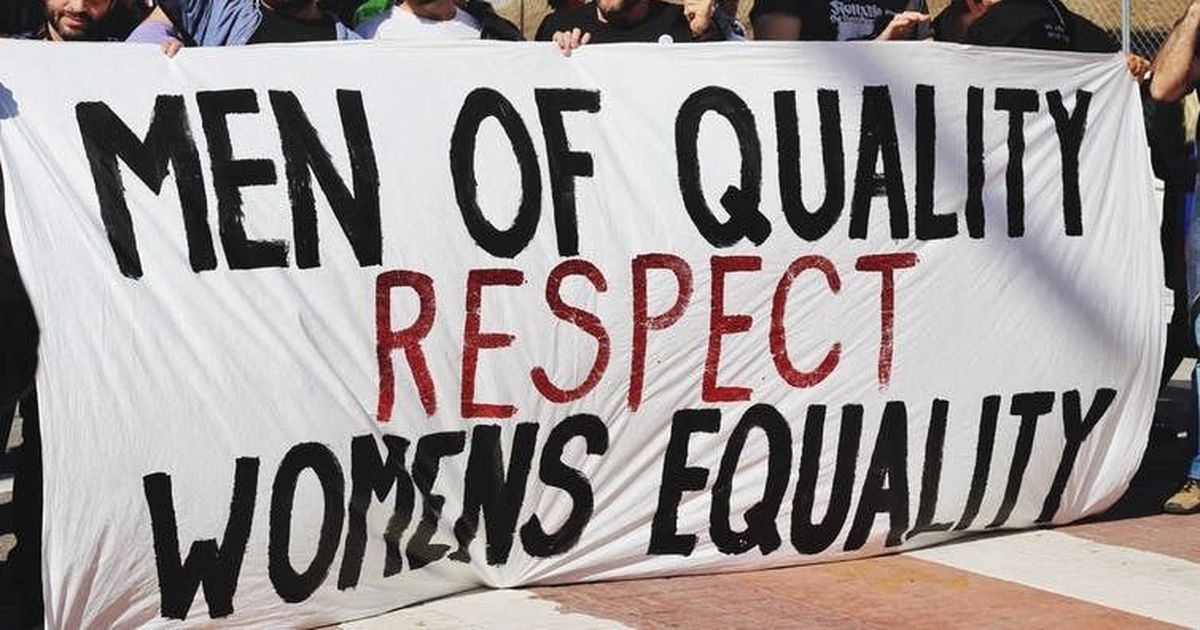
In the recent wave of MeToo stories of women having faced sexual harassment in their work lives, with revelations of how much-respected men (in positions of power) have misused their power to make unfavorable advancement towards women in their surroundings, it is time men start accepting that they have occupied too much spaces.
The new wave of feminist empowerment strategies have given strength to the women, young and old to speak out of the workplace sexual harassment they faced in recent times or years back. This has put the Bosses into uncomfortable seats at the moment of position they now hold, and MeToo campaigners and supporters are asking for resignation / stepping down of the man from the position he holds. Initially the MeToo stories were from the West – from the field of Media and Politics, then the stories from the Universities and Judicial came, and now in India in the present month of October it has moved from Films, to Media, and more to NGO stalwarts.
I work in the NGO sector and am in the ‘business’ of working for social change – with projects for development / rights of communities, and a strong focus on the marginalised sections of society, which have been defined as women, dalits, adivasis, poor, and more. In the 2 decades of my work I have slowly built a connection with the Feminist movement, and count myself as a part of it. This is not a common phenomenon as very few men associate with the women’s movement, because of its pro-active stand with women, and negation of men’s privileges. For historical reasons, men are seen as perpetrators, and women as victim. Maybe quite rightly so, for most of the incidents of violence against women, but in few instances the patriarchal mindset ingrained in society might have influenced the women and hence perpetrator – victim model might not be a good analysis for a violence case.
Having said the above that women could play an active part, and might not be a passive receiver in certain cases of violation of sexual rights, it is appropriate that men realise the privileges that men hold through ages. They have occupied spaces – and when I say this, I am counting myself as part of the human community, which has violated the spaces where men and women are supposed to have equal rights.
“I am also. a part of the problem. And while presently, I am trying to create solutions and break the chains of patriarchy, it’s not as if I have never violated the spaces.”
The sexual violence against women, is best understood from the ‘consent’ perspective. Any wooing can be interpreted as violation, if its without consent. When it comes to sexes in India, men have a tendency to be open about their sexual propositions, and women usually do not make the first move (unless it is a case some tribal community where women may be as daring).
So if a man makes an advancement towards the woman she responds with an expression to agree or disagree. There already is a myth that has been promoted in the men’s world, that a woman’s ‘No’ is actually a ‘Yes’ in her passive style of responding. It is for this reason that unless a firm loud and clear ‘No’ is not expressed, the people around do not believe in her disagreement or non-consent. This has been depicted in the film ‘Pink’. The film has also added to clarity in understanding of how a consent based touch, could move towards a non-consented sexual touch which in legal terms could be understood as attempt to rape, and hence an act of sexual violence.
The above para was about sexual harassment or violence in a relationship. Now, when there is a power dynamics between the two party, with a kind of of a hierarchy (as at workplace site), the relationship is unequal and hence the issue of consent has a different dimension altogether. Can a junior refuse to give consent to a senior, in a situation where there might be negative repercussions if the junior does so (refuses to consent, in other words objects to the act)?
Brings to my mind, the movie ‘Aitraaz’ (2004) depicting how a man was accused of sexual harassment by the senior manager (woman), and the story unfolds to show that the woman had forced herself on to the man. It was a different story, supportive of the idea that many men pose, that laws are usually biased towards women, and that men can be trapped into such incidents.
So ‘Yes’, there are a few cases where men may have got falsely ‘trapped’ in a sexual harassment case, yet it cannot be denied that in 98-99 percent of work environment men hold greater power, in terms of a senior position, permanent versus contractual position, and more. This added to the advanced form of articulation of sexual desires by men is a concoction which is commonly witnessed around. Men and boys, invading women and young girls’ spaces, crossing over the limits of body space sanctity – to touch, grope or just stare, is a phenomenon quite common. ‘Boys will be boys’ attitude prevails as boys and men are cultured in this manner. Any boy who dares to act differently is laughed at, called girlish, and more. To be masculine and ‘Mard’, boys and men are required / forced to succumb to patriarchal thoughts and acts – as a Fresher to College has to shed his ‘cowardliness’, and approach girls to say ‘Hi I Love You’, whistle at them, give them ride on the motorcycle and ‘protect’ sisters. In this way men’s sexuality gets expressed while women’s sexuality get curbed / controlled by men around her.
Now, why is it that so many MeToo incidents are being reported? It’s all because women have found ways to express themselves through various means of communication and empowerment within. They are making their position count. They have realised that when you get raped, sexually harassed then there is no ‘Izzat’ or honour which is lost, it is a physical emotional trauma that she has to pass through, and can be overcome – not like the olden days, when suicide or ‘Jauhar’ in the name of honour was a trend.
Yes, society has changed through years and there are parents who are preparing their children to resist any injustice, be it sexual violence or mental violence in the name of dowry. Parents are investing in their girl children to help them enjoy wholesome lives, through completion of their education and taking up of jobs to be self sufficient, and not rely on their husbands. This change in family systems and a fast trend in women becoming self reliant, and the communication tools advancement has together strengthened the voice of women.
Feminist Movement has started building new waves with the way ICT has contributed to campaign building. There is now a media which is more decentralized in terms of ownership, has varied channels of expression, and hence control over the writer is very little. She / He can write and self publish – make range of friends across cultural, national boundaries and receive support from the friends across the globe. The language of rights is also now more known to people – and its not just rights which the State has defined but beyond that to equate with international human rights standards. This transnational global closeness is taking movement emerging in one country to another. LGBTQ movement is one such spread of movement, and now MeToo is similarly spreading.
As every article has to come to an end, let me try summarizing this write up, and get to the point. When I said that I am part of the problem, I talk about myself and many other men who have grown up in the same Patriarchy which is so much prevalent around. And while I try to work towards women’s empowerment and gender equity, it is a tough struggle within to shatter own patriarchal values or behaviours or male privilege. This is an internal struggle which any conscientised man has to go through if he wants to shed his patriarchal chains.
Yes, patriarchal chains have harmed men too – they can’t cry, can’t express love to children the way mothers are able to, forced to follow the division of labour principle where men have to earn and women to look after households, forced to be protective in the name of family, community honour and more.
Many men might be going through this shedding of patriarchal chains as I do. But this is not to say, that I have a clean history. We, all men are waiting, when their name will appear in a MeToo allegation by someone. As men, we have all invaded women’s spaces, in some moment of time, when we were in High School, or College, or a Camp, or a Tour, or in any Job, or any unknown neighbourhood, or in a relatives / friends place and so on -the stories and experience that all men have gone through, because of the patriarchal environment we have grown in.
Its time to men to apologise to women and girls as a community, and give way to their expression and rights journey.
Dear women, there are men who trying hard to bring about a change in themselves and to other men and boys around. Men do not want to remain perpetrators and predators, they want to change. Please help the men around you to get sensitive to gender issues, respect women and transgender, and their sexuality. Together there is a need to make a community where these sexual rights and its diversity is accepted and kept free from any kind of violation. We ‘Men’ want to be good human beings as son, brother, husband, uncle, lovers and friends – help us to be so, dear women and girls !
This book is a comprehensive compilation of the incidents of sexual violence in South Chhattisgarh, drawing on independent investigations or joint fact findings by WSS. Pre-order a copy for Rs. 100…
द टाइगर के सीन पूरी रात सपनें में आते रहे. कहानी मूलतः एक बूढ़े शिकारी और एक टाइगर की थी – किस प्रकार उनकें रिश्तें स्थापित होते हैं और प्रतिद्वंदी होतें हुए भी, वें किस प्रकार सह-अस्तित्व को रूप देनें का प्रयास करतें हैं. कोरिया देश के जंगल पहाड़ में रहने वाले ये दोनों प्रोटागनिस्ट्स (protaganists) लालची शिकारियों और जापानी फ़ौज अफसरों के डोमीनेटिंग (dominating) घमंड के सामने सर न झुकाकर अपने जंगल के नियम का पालन करतें हैं. उन्हें घोर विश्वास अपने सह-जीवन के मूल्यों पर – वें कपट के सामने न झुक कर अपनी बहादुरी मरते दम तक जीना चाहतें हैं.
The Tiger is set in 1925, with Korea having already been under Japanese rule for more than two decades. Determined to crush the morale of the local population, the authorities — or, at least, the governor — is at work to exterminate the country’s tigers, an animal seen as the embodiment of the Korean national spirit. But the plan has hit a snag: Casualties are mounting as soldiers fail in their attempts to kill a remaining streak on Jirisan, one of Korea’s most sacred mountains.
As it happens, Jirisan is also the home of the film’s protagonist, Man-duk (Choi), who — as shown in the film’s prologue — was once the best and most dignified hunter in the region. By the time he is summoned to the governor’s office in 1925, he has already become a wreck, a sickly widower who long ago traded in his shooting prowess for an alcohol-fueled existence. As Man-duk retreats into his stupor, other desperate hunters of more questionable skill come to the fore — namely a gang led by the callous Gu-kyung (Jeong Man-sik). They are soon joined by Man-duk’s son Seok (Sung Yoo-bin), a teenager hoping to earn some money and pedigree so he can marry his sweetheart.
Of course, Man-duk doesn’t stay out of the picture for long. Shocked into sobriety when he realizes Seok has joined the deadly mission, the decommissioned hunter finally reawakens his old self when tragedy strikes. Through flashbacks, we learn that Man-duk and the tiger have met previously and, despite having killed each one another’s loved ones, are more kindred spirits than sworn enemies. Both the hunter and his quarry abide by a moral code which has become passé at a time when cynicism reigns and the powerful (in this case, the Japanese occupiers) play locals against each other.
अश्विनी ने जब पूछा की फिल्म कैसी लगी तो मैंने कहा – ‘बहुत बढ़िया, दोनों ही शेर थे और शेर की तरह जीए’. एक समय शिकारी ने टाइगर की मदद की थी (बचपन में उसकी रक्षा की थी, खिलाया था) तो टाइगर भी शिकारी के बेटें पर वार नहीं करता हैं (जब बेटे को जापानी, शिकार समूह का हिस्सा बनानें में कामयाब हो जातें हैं, इस आशा में की बूढा शिकारी भी अपने बेटे के साथ टाइगर पकडनें में मदद करेगा). अंतिम क्षणों में जब लालची शिकारियों और जापानियों के विन्धवस्कारी रणनीतियों के कारण शिकारी का सोलह वर्षीय बेटा मर जाता हैं और टाइगर के भी परिवार का अंत हो जाता है और वह लड़ते लड़ते घायल हो चूका हैं, तब वह शिकारी से मिलने उसके घर जाता हैं. दहाड़ता है ‘देखो मित्र तुम भी घायल हो और मै भी’. बूढा शिकारी भी समझ जाता हैं ‘अब शायद समय आ गया हैं की हम अपना अंतिम खेल खेलें’. अंतिम खेल, यह दो दोस्त टाइगर की गुफा के पास पहाड़ के ऊपर पर खेलते हैं. बर्फ की सर्दी में वें दोस्त अपना खेल करते हुए नीचे (जानबूझ कर) गिरते हैं और पहाड़ की बर्फ में दफन हो जातें हैं.
निर्दयी, लोभी शिकारीदल जो जापानी फ़ौज के साथ शिकार पर हैं इन दोनों शेरों को नही पकड़ पाते हैं – गायब हो जाते हैं ये पहाड़ के देवता. और कायम रहता हैं बहादुर, अपराजित भगवान् पर विश्वास जो जंगल पहाड़ की रक्षा करता हैं. क्या यह विश्वास गलत हैं की एक शक्ति प्रकृती की रक्षा कर रही हैं जिसका विन्ध्वंस करना, गलत हैं और ना-मुमकिन भी. प्रकृति पर विजय हासिल करने का मानवीय षड़यंत्र सह-अस्तित्व, सह-जीवन को किस प्रकार नष्ट करने का प्रयास करता है, यह फिल्म इसी को प्रदर्शित करती हैं.
इस फिल्म ने मुझ पर बड़ा प्रभाव छोड़ा – जो जंगल बुक से और आगे था. दोनों ही फिल्मों में सह-अस्तित्व और सामूहिकता का स्वर सुनायी देता हैं – और चालाक षड्यंत्रों को हराने की उम्मीद जगाती हैं. लेकिन इस फिल्म में बुढा शिकारी शायद बहुत दर्शकों को उम्मीद देगा जो कठिन दौर में भी विशवास को डगमगानें नहीं देतें हैं. वह विशवास और अपने मूल्यों के प्रकृति मूल्यों के प्रति प्रतिबद्धता – ठंडी हवाएं चलें, बीमारी जकड़ लें, अपनी राह में अकेले हो जाएँ – फिर भी ज़िंदगी आगे बढ़ते रहने का नाम हैं.
शायद जिस प्रकार से बूढ़े शिकारी में जो ताक़त प्रदर्शित हैं वह असलियत में आज के दौर में नहीं दिखती लेकिन तो भी यह फिल्म उन पुरानी कहानियों की याद दिलाती हैं जब इंसान के पास सिर्फ दो मुख्य चीजें थी – एक अपनी शारीरिक ताक़त, हुनर एवं दूसरा उसकी मानसिक, भावनात्मक ताक़त – और पूंजीवादी जीवन पद्दती पुरे तरह घर नहीं कर गयी हैं. पहाड़ के भगवान् टाइगर के प्रति श्रधा और अपने सह-जीवन मूल्यों से प्रेम के बीच हमारें आदिवासियों के बीच अभी पूंजी भी घर बनना रही हैं क्योंकि सामाजिक आर्थिक जन जीवन में अब प्रति-स्पर्धा ही नहीं परन्तु ‘सरवाईवल ऑफ़ द फिट्टेस्ट’ (Survival of the Fittest) मूल्य काम कर रहा हैं – जो समय के साथ ‘फिट’ रहेगा वह ‘प्रगति’ करेगा और बाकी लाइन में इन्तेज़ार करतें रहेंगें . बढ़ते व्यक्तिवादी जीवन में हमें अपने अस्तित्व की चिंता हैं और प्रकृति समाज के संतुलन पर हमारा ध्यान ही नहीं हैं. कोरिया देश में जापानी, लूट की प्रवृति प्रोत्साहित करतें रहे और कुछ पूंजीवादी मूल्य इसी प्रयासों में देशज लोगों में घर कर गए.
एक राजनैतिक कमेंट करती हैं यह फिल्म – अपने सह-जीवन के मूल्यों के प्रति और पूंजीवादी, व्यक्तिवादी रणनीतियों के विरुद्ध. बूढ़े शिकारी का चित्रण आशा, उम्मीद जगाता हैं.
आयोजन के लिए धन्यवाद
फिल्म का आयोजन हुआ था रांची शहर में ‘साल सकम’ समूह द्वारा. और क्यूँकी भारत के पठारी क्षेत्र में रहने वाले आदिवासियों का रांची एक मुख्य केंद्र हैं इसलिए ऐसे चर्चाएँ जिनका सन्दर्भ आदिवासी जन-जीवन एवं प्रकृति से जुड़ा हुआ है, यह समूह कुछ अंतराल में, आयोजित करने की कोशिश करता हैं.
फिल्म जबरदस्त थी. लेकिन क्योंकि कोरियाई भाषा में थी, अंग्रेजी सबटाईटेल्स के साथ, इसलिए मुझे लगता है की फिल्म प्रदर्शन के दौरान २-३ मध्यांतर करने की आवश्यकता थी की अंग्रेजी ना पढ़ सकने वाले हिंदी भाषी लोगों के लिए कुछ फिल्म अनुवाद किये जा सकें.
द टाइगर के सीन पूरी रात सपनें में आते रहे. कहानी मूलतः एक बूढ़े शिकारी और एक टाइगर की थी – किस प्रकार उनकें रिश्तें स्थापित होते हैं और प्रतिद्वंदी होतें हुए भी, वें किस प्रकार सह-अस्तित्व को रूप देनें का प्रयास करतें हैं. कोरिया देश के जंगल पहाड़ में रहने वाले ये दोनों प्रोटागनिस्ट्स (protaganists) लालची शिकारियों और जापानी फ़ौज अफसरों के डोमीनेटिंग (dominating) घमंड के सामने सर न झुकाकर अपने जंगल के नियम का पालन करतें हैं. उन्हें घोर विश्वास अपने सह-जीवन के मूल्यों पर – वें कपट के सामने न झुक कर अपनी बहादुरी मरते दम तक जीना चाहतें हैं.
The Tiger is set in 1925, with Korea having already been under Japanese rule for more than two decades. Determined to crush the morale of the local population, the…
This write up is in the backdrop of what Anand Pawar wrote on Facebook –
“All of us working with men and on masculinity are so busy celebrating our ‘successes’, collecting (many a times) superficial stories of change, approving or disapproving one’s work, gathering number of ‘transformed men’, publishing materials, creating our ‘hegemonies’ etc… that we never created spaces to discuss our failures, never engaged in critical discussions on whether our projects are really creating long-term impact, as compared to resources we spend on this work. ”
In response to this Abhijit Das writes
“Unfortunately the development business doesn’t encourage reflection. We are all trying to sell our successes. The work with men is particularly vulnerable as all of us are trying ‘advocate’ without a clear grasp on the fundamental issues in many cases.“ Meena Seshu brings a very personal touch to the discussions from her own family experience and reflects
“I live with a boy[son] and man[husband]… the fear of being `real’ is so scary for them that they prefer to accept they have deeper feelings. what to do?Why deal with the inconvenient when when it is so easy not to deal with it?”
Quite a reflective discussion happening all over around us amongst people who are ready to delve into uncomfortable zones of thoughts – ideas which are not in line with the present day societal thinking and practice. Working with men does remains a big challenge to the development sector and feminists.




 In the recent wave of MeToo stories of women having faced sexual harassment in their work lives, with revelations of how much-respected men (in positions of power) have misused their power to make unfavorable advancement towards women in their surroundings, it is time men start accepting that they have occupied too much spaces.
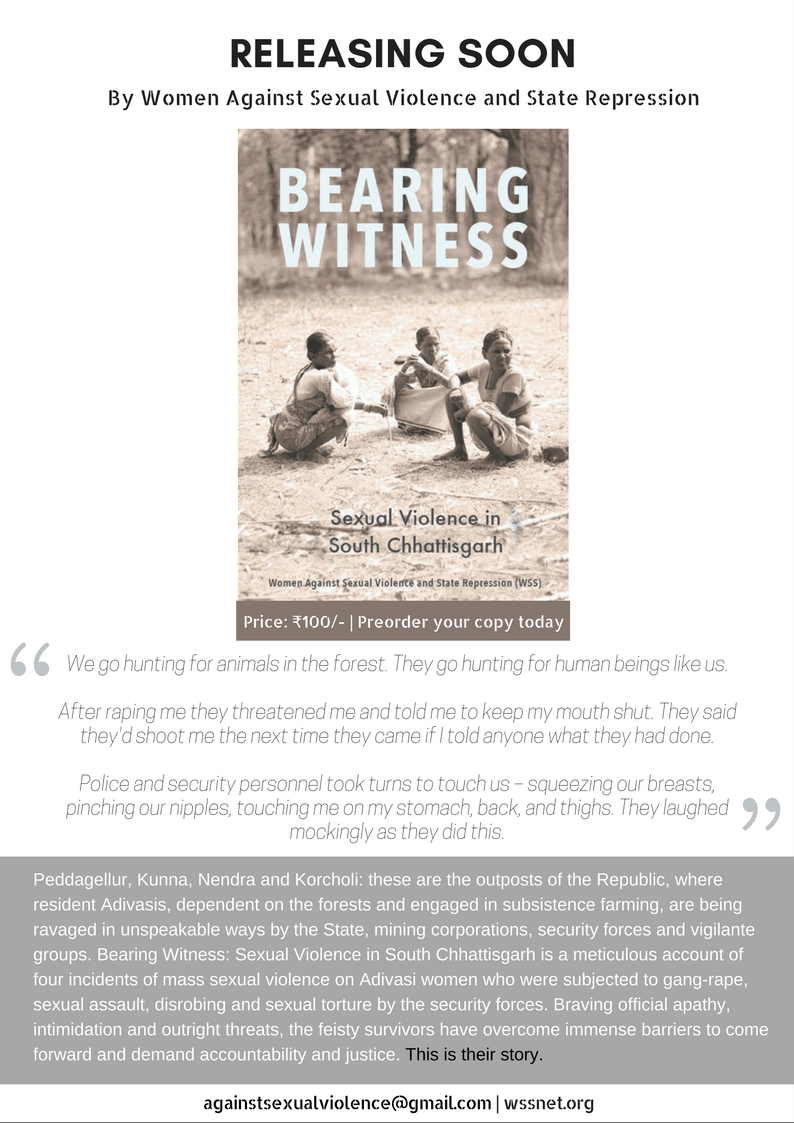 This book is a comprehensive compilation of the incidents of sexual violence in South Chhattisgarh, drawing on independent investigations or joint fact findings by WSS. Pre-order a copy for Rs. 100…
 ore than two decades. Determined to crush the morale of the local population, the authorities — or, at least, the governor — is at work to exterminate the country’s tigers, an animal seen as the embodiment of the Korean national spirit. But the plan has hit a snag: Casualties are mounting as soldiers fail in their attempts to kill a remaining streak on Jirisan, one of Korea’s most sacred mountains.
 अश्विनी ने जब पूछा की फिल्म कैसी लगी तो मैंने कहा – ‘बहुत बढ़िया, दोनों ही शेर थे और शेर की तरह जीए’. एक समय शिकारी ने टाइगर की मदद की थी (बचपन में उसकी रक्षा की थी, खिलाया था) तो टाइगर भी शिकारी के बेटें पर वार नहीं करता हैं (जब बेटे को जापानी, शिकार समूह का हिस्सा बनानें में कामयाब हो जातें हैं, इस आशा में की बूढा शिकारी भी अपने बेटे के साथ टाइगर पकडनें में मदद करेगा). अंतिम क्षणों में जब लालची शिकारियों और जापानियों के विन्धवस्कारी रणनीतियों के कारण शिकारी का सोलह वर्षीय बेटा मर जाता हैं और टाइगर के भी परिवार का अंत हो जाता है और वह लड़ते लड़ते घायल हो चूका हैं, तब वह शिकारी से मिलने उसके घर जाता हैं. दहाड़ता है ‘देखो मित्र तुम भी घायल हो और मै भी’. बूढा शिकारी भी समझ जाता हैं ‘अब शायद समय आ गया हैं की हम अपना अंतिम खेल खेलें’. अंतिम खेल, यह दो दोस्त टाइगर की गुफा के पास पहाड़ के ऊपर पर खेलते हैं. बर्फ की सर्दी में वें दोस्त अपना खेल करते हुए नीचे (जानबूझ कर) गिरते हैं और पहाड़ की बर्फ में दफन हो जातें हैं.
 के विरुद्ध. बूढ़े शिकारी का चित्रण आशा, उम्मीद जगाता हैं.
 ore than two decades. Determined to crush the morale of the local population, the…
