
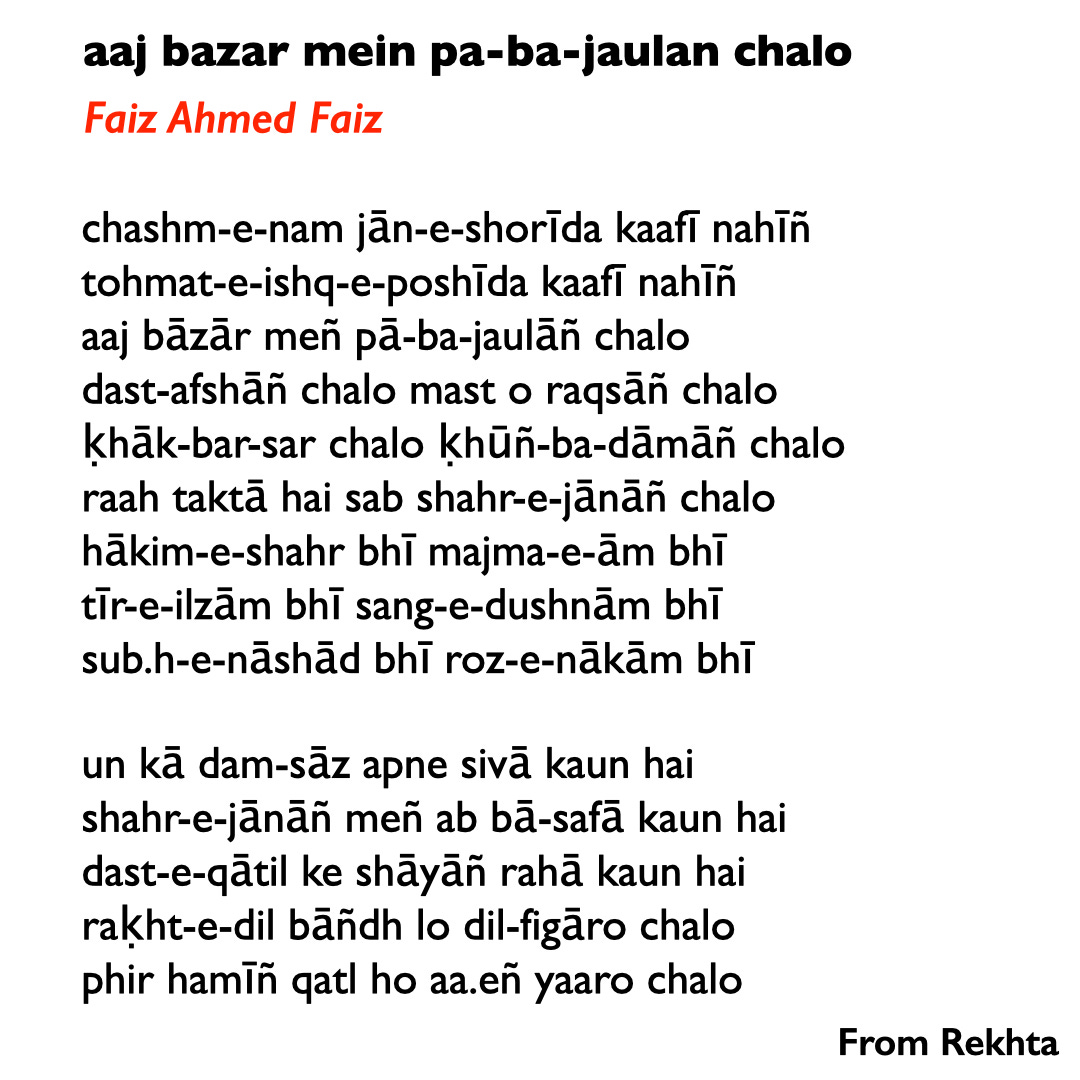
Aaj bazaar main pa ba jolan chalo
aaj bazaar main pa bajolan chalo
let us walk in bazaar in shackles
Chashm-e-nam, jaan-e-shoreeda kafi nahin
wet eyes and restless soul is not enough
Tohmat-e-ishq-posheeda kafi nahin
being charged for nurturing concealed love is not enough
aaj bazaar main pa-bajolan chalo
let us walk in bazaar in shackles
Dast afshan chalo, mast-o-raqsan chalo
let us go with afshan in hand, in trance and dancing
Khak bar sar chalo, khoon badaman chalo
go with dust on head and blood on garb
Rah takta hai sub shehr-e-janaan chalo
Go as the city of my beloved is waiting
Hakim-e-shehr bhi, majma-e-aam bhi
City’s ruler and crowd of commoners
Teer-e-ilzam bhi, sang-e-dushnam bhi
arrow of false charge, stone of accusation
Subh-e-nashaad bhi, roz-e-naakaam bhi
morning of sorrow, day of failure
Unka dum-saaz apnay siwa kaun hai
who is their friend except me
Shehr-e-janaan main ab baa-sifa kaun hai
who is untainted in the city of beloved
Dast-e-qatil kay shayan raha kaun hai
who deserve the killers or executioners hand
Rakht-e-dil bandh lo, dil figaro chalo
get ready for the journey of heart, go wounded heart
Phir hameen qatl ho aain yaro chalo
let me go to be executed
In addition to vocabulary, Urdu poetry has also acquired its richness from Persian. Perhaps similarities in culture and religion also helped our poetry to absorb Persian traditions. As an example see following Persian couplet:
Mayan-e ma o zahid een qadur ber farq daa
Ke mun der ko chau bazaar o der khana me raqsadi
Translation: (The only difference between me and zahid (a pious man) is that I dance in bazaar and streets and he dances within the four walls of his home).
Here the word raqs includes all those acts that society regards as sin. However, the real beauty lies in the meaning that is beyond words. We both are sinners; the difference is that I sin openly and he (who is called pious) sins quietly. One can also say that he is admitting that he is a sinner but zahid is not only a sinner but also a hypocrite. He is saying that the world knows what he is but does not know what zahid is. No matter how you try to understand the poet is expressing a deep disdain for munafiqat and deceitfulness.
I do not know Persian but have quoted it as an example as to how Urdu poetry has borrowed depth and rich traditions from Persian. There are two words in the Persian couplet that I have quoted that Faiz’s has also used: Bazaar and raqs. Incidentally both words symbolize more or less similar meaning in Urdu as well as Persian verses.
The poem’s literal meaning is easy to appreciate. If someone does not understand a word or two then dictionary would help. However, the poem’s beauty is wrapped in a language of symbols, references, metaphors and similes. The theme of the poem is defiance as against compliance and submissiveness. There is a burning desire in a confined soul to be free of restrictions, exploitation and injustice.
In the first seven lines he is referring to love that could be a personal affair and nothing to do with the society at large. But a little reflection would reveal that the real meaning is different then superficial meaning. He is willing to face public ridicule and wrath of the powerful for his love. Wet eye and restive soul are the symbol of endurance in silence as against walking in shackles, dancing in bazaar and blood on garb is a sign of defiance. As if he can not endure to suffer in silence any more. He is sick and tired of the restraints and limits placed by the society and by those who have power; political masters, social order, age old traditions, the religious establishment and the society at large.
The poet’s path takes an obvious turn from the eighth line when he talks of the ruler and the crowd; a symbol of power, established order and manipulation of commoners by ruler or moulvi. The imagery is extremely powerful. How he is made a target of falsehood. Though he fights, he is also full of sadness because he knows that truth will not prevail. That is why he talks of morning of sorrow and of day full of grief in the tenth line.
However, he does not let his sorrow overcome the purpose he has set for himself: to fight for the dispossessed. Here it is important to keep in mind who is he referring to when he said unka in eleventh line; clearly unka includes all downtrodden, exploited and deprived. When he says who is their friend except me, he is in fact grieving that all those who could take a stand are now corrupted and he does not find a single pure soul (ba-sifa). Hence, he feels that he is left to fight against injustice. Finally he gets ready to offer the supreme sacrifice.
References to concealed love and city of beloved should not be confused with poetry of ordinary love in the traditional sense. As love is symbol of purity and a true lover can not be a hypocrite that is why he has used that symbol. His main theme is to fight against injustice and repressive forces of the society.
Faiz’s Aaj Baazaar Mein – Translated and Explained
Last updated on: November 1, 2022 at 1:05 pm by Andrew Harvey
https://www.patheos.com/blogs/drishtikone/2012/07/faizs-aaj-baazaar-mein-translated-and-explained
===
आज बाज़ार में पा-ब-जौला चलो
चश्म-ए-नम जान-ए-शोरीदा काफी नहीं
तोहमत-ए-इश्क़ पोशीदा काफी नहीं
आज बाज़ार में पा-ब-जौला चलो
दस्त-अफ्शां चलो, मस्त-ओ-रक़्सां चलो
खाक-बर-सर चलो, खूं-ब-दामां चलो
राह तकता है सब शहर-ए-जानां चलो
हाकिम-ए-शहर भी, मजम-ए-आम भी
तीर-ए-इल्ज़ाम भी, संग-ए-दुश्नाम भी
सुबह-ए-नाशाद भी, रोज़-ए-नाकाम भी
इनका दमसाज़ अपने सिवा कौन है
शहर-ए-जानां मे अब बा-सफा कौन है
दस्त-ए-क़ातिल के शायां रहा कौन है
रख्त-ए-दिल बांध लो दिलफिगारों चलो
फिर हमीं क़त्ल हो आयें यारों चलो
आज बाज़ार में पा-ब-जौला चलो
===
Aaj Bazar Mein Pa-ba-jaula Chalo | Walk through the bazaar today with feet in chains
Faiz Ahmed Faiz
Apr 30, 2022
January
Children’s fingerprints
On a frozen window
Of a small schoolhouseAn empire, I read somewhere
Maintains itself through
The cruelty of its prisons
– Charles Simic
How is it that entire discourses of resistance can be launched in a few precisely chosen words, haiku-like in their delineation of the landscape? Entire systems of oppression can be brought to their knees by the utterance of truths that are juxtaposed with the raw nakedness of sight. When I first shared Simic’s lines on this platform, I did not speak so much about their revolutionary power. I spoke about sparseness, and how the world could be compressed into words that in their singularity, convey, not only image, but movement, and a complex interplay of ideas beyond the static frame of the poem itself. Simply, through juxtaposition, Simic lays bare what education can become, how ‘empire’ tightens its grip through the prisons it creates, even for its children.
Last Saturday, newspapers reported that verses of Faiz (among other allegedly ‘incendiary’ posters and content) were removed from 10th standard CBSE Social Science Textbooks. Among other quotes, the translation of a passage from this poem was excluded.
The translation I have done is culled and recreated from different sources including the version used in the Merchant Ivory production ‘In Custody’, and Rekhta.
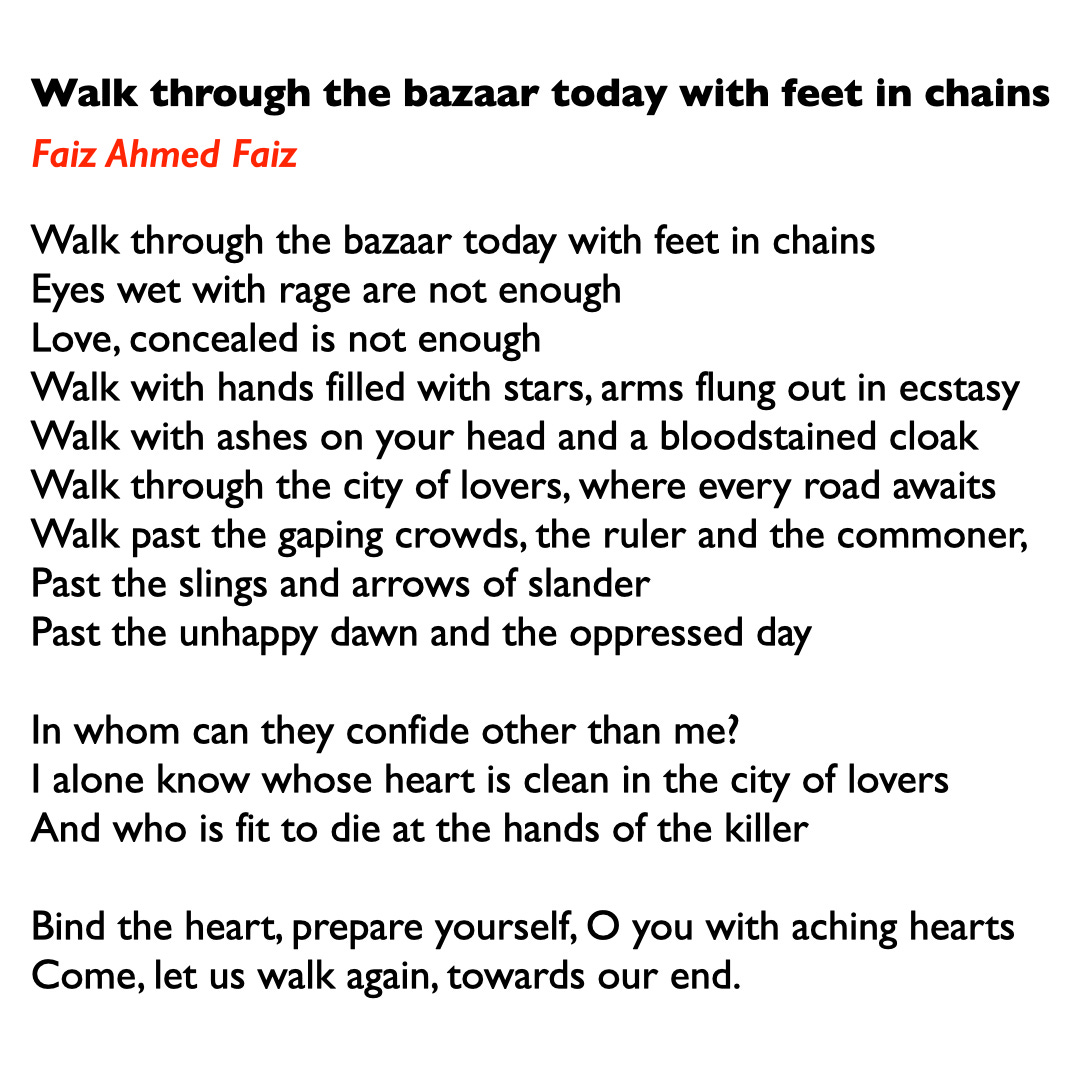

Can empire erase memory? Can it rewrite history? It is attempting to, and even creating versions of it to suit its thorny project of colonising the present, with imagined pasts. The thing that the empire fears the most is love. It fears openness of expression, empathy, and calls for unity. It fears the surging ocean that laughter can bring. It fears irony, and the upturned head of a man walking through the bazaar with shackles on his feet. It fears defiance, and the refusal to accept humiliation and punishment.
Faiz’s landmark poem was written when he himself was being taken to jail in chains, for his defiant stance, and his open satire, and critique of fascist policies. ‘Walk past the gaping crowds’, he says. Let the fetters shine in the sun. Let them see you laugh, and ‘dance in ecstasy’ – no shackles can imprison the imagination.
This is what the empire fears – that its subjects can ride on the wings of imagination, something that they cannot control. What fake imagery, and violent rhetoric will you thrust in ‘hands filled with stars’? Fascists require the slate to be clean, that children can be conditioned into their limited fantasies of purity. They see children as the footsoldiers of their vision, and they use the double-edge sword of censorship and propaganda to aid this endeavour. Their anti-intellectualism is marked by the threat of the creation of ideas, of curiosity. They want to quell individuality, and the possibility of realities that do not suit their agenda, imaginations that they cannot regulate.
Sometimes, I feel, that the best thing that a government can do a text is ban it. I remember the sudden interest that was garnered around A. K. Ramanujan’s essay “Three Hundred Ramayanas” which was removed by the UGC from College syllabi. I was a student, at the time, and was perplexed by the logic of that removal. The fascinating essay propelled mythology as multi-faceted, open ended, and constantly evolving – more retelling, than sacrament. Ramanujan opened up a world of colourful, diverse mythologies for me, and made me love the changing narratives of gods and people, in a manner that was not restricted, and that taught me about the complex scripts of culture. Faiz’s words have done this too, for many, even years after they were written. They have the power to gather crowds.
What a state cannot understand, it attempts to decimate, but the shard of light that is knowledge, shines through the crack, always.
I share these verses in solidarity, today, and in the hope that our young may learn of the constant attempts to kill ideas, and the value of equality.
If the poetry and the commentary resonate with you, do consider ‘buying me a coffee’.
(Matlab, if you can’t, that’s also fine, obviously. This will always be a free newsletter)
—
Note: Those, not in India, who’d like to support the work I do at Poetly, do write to me – poetly@pm.me. (Apologies, I will figure out international payments soon)


By Toronto based Poet, Anis Zuberi
Courtesy, Junaid Zuberi

